What is custom CNC machining?
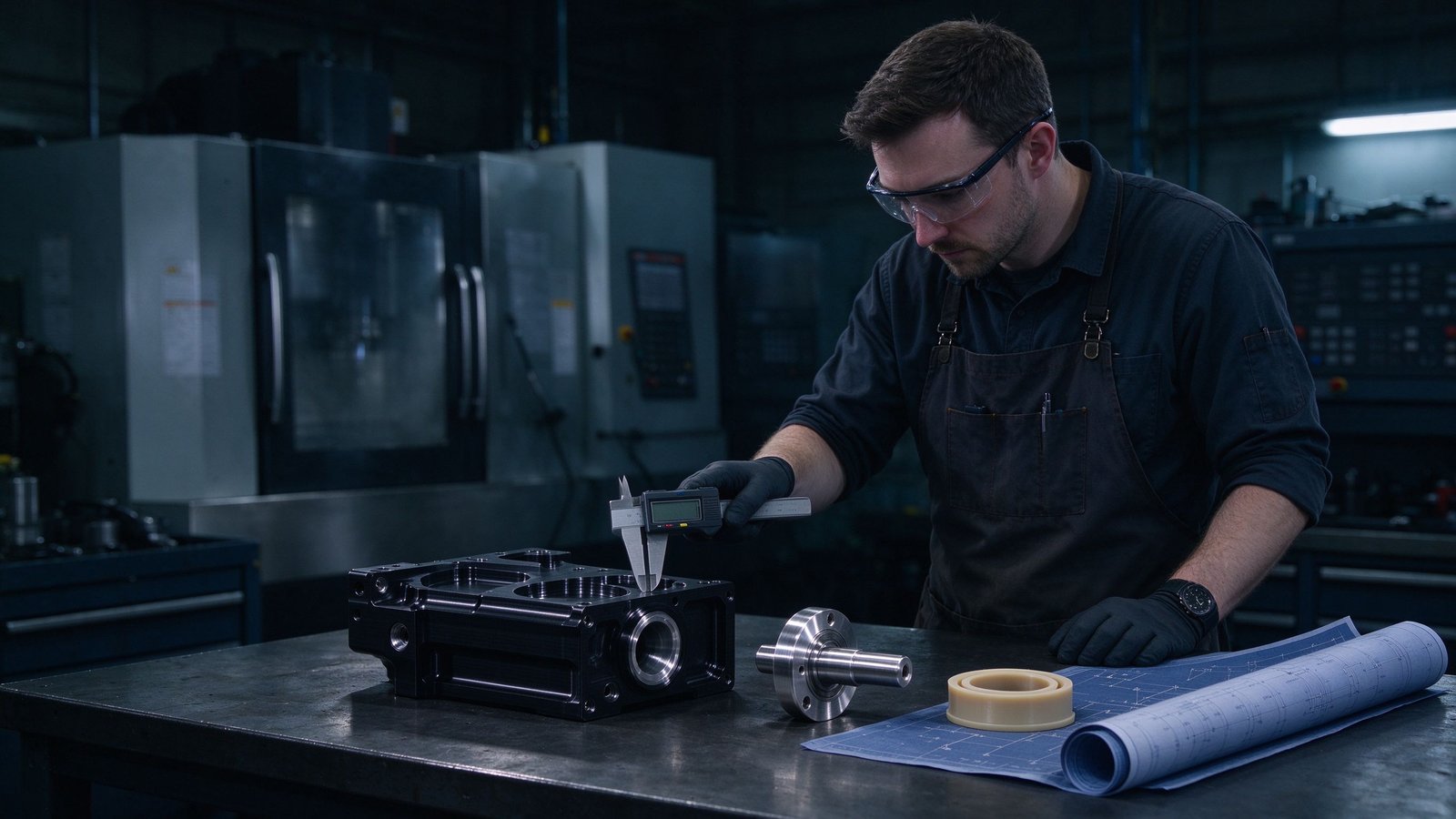
Custom CNC machining is the production of parts that are designed by you — your geometry, your tolerances, your materials — rather than picked from a catalogue. The supplier programs the machine from your drawings or 3D model, cuts the part from solid stock, and inspects it against your specification. Because there is no mould and no tooling, custom machining is the natural route for prototypes, first articles, and low-to-mid volume production of CNC precision parts: brackets, housings, shafts, fittings, plates, gears, insulators and any other component an engineer can draw.
At YOUSU, every job is a custom job. We machine one-off prototypes and repeat batches with the same ISO 9001 process, so the part you approve as a sample is exactly the part you receive in production. See the range on our CNC machined parts gallery.
The custom part process: from drawing to delivery
A custom CNC project follows a clear sequence. Understanding it helps you prepare the right information and set realistic expectations.
- 1. Drawing and model. Send a STEP/IGES 3D model for geometry plus a 2D drawing (PDF/DXF) with tolerances, threads, material and finish callouts. Complete information is the difference between a firm price and a provisional one.
- 2. Free DFM review. Our engineers check machinability, wall thickness, internal corners, tolerances and finishing — see our CNC design guidelines for the rules they apply. Issues are flagged before metal is cut.
- 3. Quotation. You receive an itemised price and a written lead time within 24 hours. We quote the process that fits the part — we do not push work onto a more expensive machine than it needs.
- 4. Material and programming. The correct stock is sourced and certified if required, and the CAM program, tooling and fixturing are prepared.
- 5. Machining. The part is machined on the most suitable machine — 3-axis, turning, turn-mill, 5-axis or gantry — in one or as few setups as possible. See milling vs turning to understand how the process is chosen.
- 6. Finishing and secondary operations. Anodising, bead blasting, plating, passivation, heat treatment or assembly are applied as specified.
- 7. Inspection and delivery. Critical dimensions are verified with a CMM; first-article reports and material certificates are available on request. Parts ship worldwide, including DDP to Europe.
Choosing materials for custom CNC parts
Material choice drives strength, weight, corrosion resistance, cost and lead time. The most common CNC materials and their roles:
- Aluminum (6061, 6063, 7075): lightweight, fast to machine and easy to anodise — the default for housings, brackets, plates and automation parts. Compare aluminum vs stainless steel and 6061 vs 7075.
- Stainless steel (304, 316): strong, corrosion- and heat-resistant — for shafts, couplings, marine, food and medical components. Explore our stainless steel CNC machining.
- Engineering plastics (PEEK, PEI, POM, nylon): light, insulating and chemical-resistant — for insulators, gears, bushings, test fixtures and high-temperature parts. Read the PEEK vs PEI vs POM guide.
- Brass and copper: fast-cutting, conductive — for fittings, electrical and thermal parts. See our brass & copper guide.
- Titanium and exotic alloys: for aerospace and demanding high-strength applications, machined with specialised tooling and coolant.
Not sure which grade? Tell us the operating environment, load, weight limit and finish, and we will recommend a grade during the free DFM review.
Milling, turning and 5-axis for custom geometry
Custom parts come in every shape, so the machine must match the geometry:
- CNC milling handles prismatic parts — housings, brackets, manifolds, plates and 3D contoured features — on 3-axis and multi-axis centres. Visit our CNC milling services.
- CNC turning produces round parts — shafts, pins, bushings, fittings and threaded components — fast and economically, with live-tool turn-mill for mixed round-and-prismatic features. Visit our CNC turning parts.
- 5-axis machining reaches five faces and free-form surfaces in one clamping, holding tighter alignment for complex parts such as impellers, robot joints and aerospace components. Learn when 5-axis is worth it and see our 5-axis capability.
- Gantry machining handles large aluminium plates — base plates, fixture plates and cooling plates — with controlled flatness. See our gantry plate machining.
Our equipment list in the facility section shows the full machine base: 3-axis, 5-axis, gantry, turning and Swiss-type machines under one roof.
Finishing and secondary operations
The machined surface is rarely the final surface. Common finishing for custom parts includes:
- Anodising (clear, black, coloured and hard Type III) for aluminium — wear and corrosion resistance plus a controlled appearance. Read our anodising guide for thickness and design tips.
- Bead or sand blasting for a uniform matte finish that hides tool marks.
- Powder coating and painting for tough coloured protection on metal parts.
- Passivation and electropolishing for stainless steel, improving corrosion resistance and surface quality.
- Plating (nickel, tin, zinc) where conductivity, solderability or corrosion protection is required.
- Assembly and inspection — inserts, fasteners, pressure testing and packaging as part of the order.
Specify the finish on the drawing and we will dimension critical features for the process — for example, allowing for anodising growth on tight bores and threads.
Precision, tolerances and inspection
Precision is what makes a custom part a precision part. A professional CNC manufacturer controls it end to end:
- Tolerances: default to ISO 2768-mK, with ±0.01 mm routinely held on critical features where the design and material allow. Our tolerance and surface finish guide explains what to specify.
- Inspection: in-process checks, first-article inspection (FAI) and final CMM dimensional reports on request.
- Traceability: material mill test certificates (EN 10204 3.1) for critical and certified parts.
- System: an ISO 9001 quality system covering drawing review, process planning, machining and inspection.
Ask for a CMM report and material certificates on your first order — a supplier that documents quality is a supplier you can scale with.
Working with a custom CNC partner
The value of a custom machining partner is not only the machine time — it is engineering judgment. A good partner reviews your design for manufacturability, recommends materials and finishes, chooses the most economical process, holds the tolerances that matter and keeps one engineering contact from quote to delivery. That is how we work at YOUSU: ISO 9001 certified in Shenzhen since 2014, exporting precision-machined metal and engineering-plastic parts to Europe and worldwide, with DDP shipping handled on the quote so the price you see is the price you pay — see our China-to-Europe DDP guide.
For new projects, start with a CNC rapid prototype to validate the design, then scale to production with the same supplier. Send your drawings for a free DFM review and a quote within 24 hours.
Frequently asked questions
What does custom CNC machining mean?
It means producing parts to your own drawings or 3D model rather than from a catalogue — programmed, machined and inspected for the specific job, with no mould or tooling investment, from single prototypes to low and mid volume production.
How fast can I get custom CNC machined parts?
With complete drawings, prototypes are typically machined within 5–10 working days, and we return a quotation within 24 hours. Production batches depend on quantity, material and finishing such as anodising, with the schedule confirmed in writing on the quote.
Which materials can be custom CNC machined?
Aluminum (6061, 6063, 7075, 5083), stainless steel (304, 316), brass and copper, titanium, and engineering plastics including PEEK, PEI (Ultem), POM (Delrin), nylon and PPS. The right grade depends on strength, weight, corrosion, temperature and cost.
What tolerances can you hold on custom parts?
Our default follows ISO 2768-mK, and we routinely hold ±0.01 mm on critical features with CMM-verified setups. Tight tolerances are applied only where the design needs them, because over-specifying raises cost.
What do I need to send to get a custom CNC quote?
A 3D model (STEP or IGES) plus a 2D drawing (PDF or DXF) with tolerances, threads, material and surface-finish callouts, together with the quantity and any certification requirements. A free DFM review flags design issues before metal is cut.