
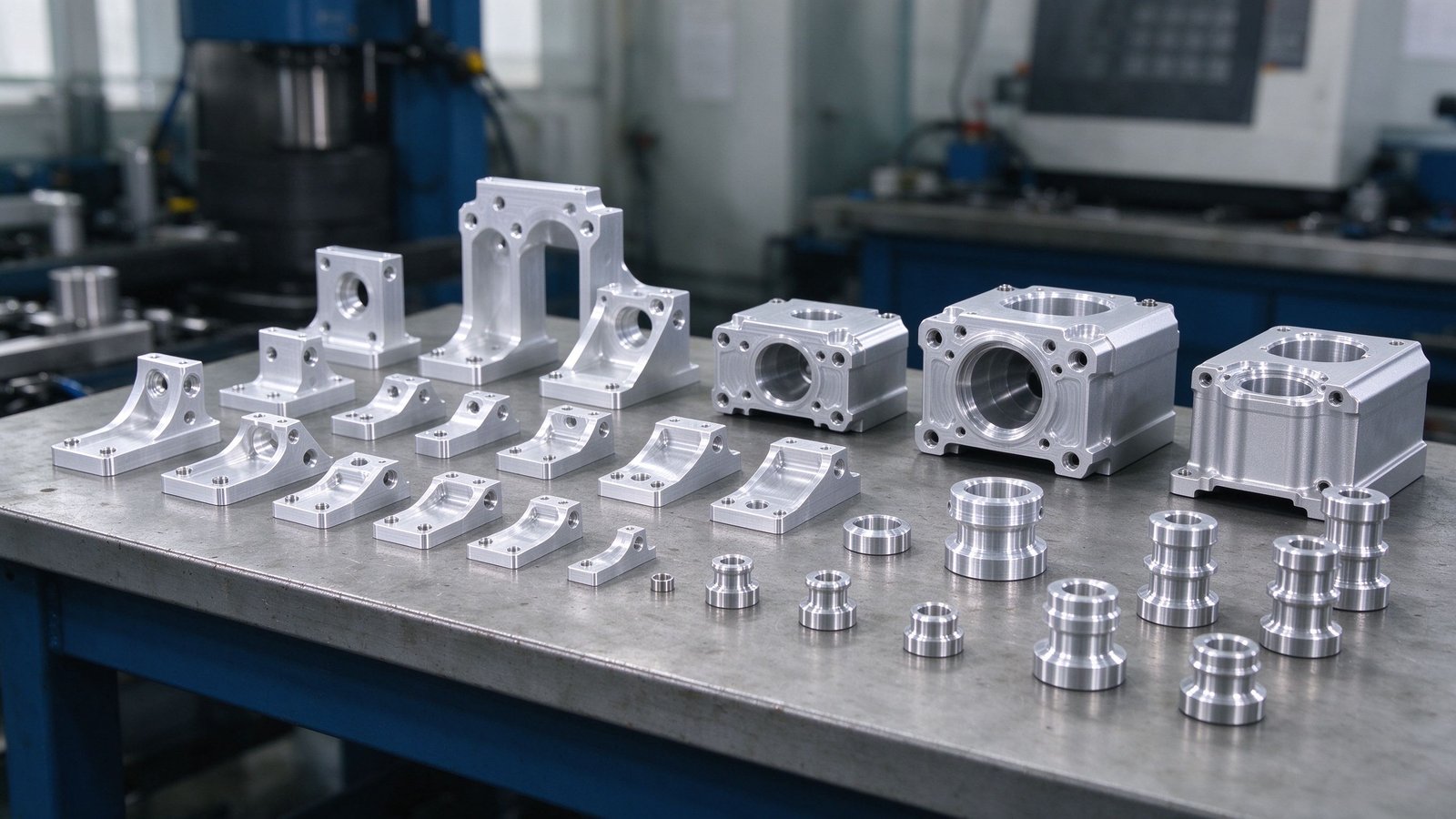
What is CNC rapid prototyping?
CNC rapid prototyping is the use of CNC milling and turning to produce functional, one-off or small-batch parts directly from a CAD model, with no mould. The machine cuts away material from a solid block of metal or plastic to leave the finished part. Because it uses the same materials, tolerances and finishes as the eventual production process, a CNC prototype doesn't just look like the final product — it behaves like it, which makes it suitable for real fit, mechanical and thermal testing.
Why teams choose CNC for prototypes
- No mould or tooling: machining starts as soon as the model and program are ready, so budget goes into testing the design rather than into a tool that may be scrapped after a revision.
- Fast turnaround: simple prototypes can ship in a few days rather than the weeks a mould requires.
- Real engineering materials: aluminium, steel, stainless, brass and engineering plastics such as POM and PEEK — essential for meaningful functional testing.
- Accuracy and finish: parts hold production-like tolerances and can be anodised, plated or bead blasted, so the prototype is genuinely representative.
- Quick design changes: a revision only needs an updated model and program, allowing several iterations in the time one mould would take.
CNC machining vs 3D printing vs injection moulding
| Factor | CNC machining | 3D printing | Injection moulding |
|---|---|---|---|
| Best for | Functional prototypes | Form/fit, complex shapes | High-volume production |
| Upfront tooling | None | None | Expensive mould |
| Materials | Real metals & plastics | Limited polymers | Wide, but mould-bound |
| Tolerance / finish | High | Moderate | High |
| Cost at low quantity | Moderate | Lowest | Very high |
| Cost at high quantity | Higher per part | Slow, not suited | Lowest per part |
A common approach is to use 3D printing for early form studies, CNC for functional prototypes and pre-production validation, and injection moulding once the design is locked and volume is high. For plastic parts at the crossover point, see moulding vs CNC.
Lead time, tolerance and cost
- Lead time: about 1–5 working days for simple parts and around 3–7 working days for typical rapid prototypes, depending on material, post-processing and whether expedited service is used.
- Tolerance: around ±0.05–0.1 mm on general features, with ±0.01–0.025 mm achievable on critical features.
- Cost: rapid prototypes from Chinese suppliers are commonly around 30–60% below comparable US and EU shops for the same specifications. The first part carries the setup cost, so ordering a small batch (e.g. 5–10) lowers the cost per unit — see how quantity affects price.
The prototype workflow
- Send a 3D model (STEP/IGES) and a 2D drawing with material, tolerance and finish callouts.
- We run a quick DFM review, confirm feasibility and quote, often the same day.
- On approval, toolpaths are programmed and the part is machined from selected stock.
- Parts are deburred, finished and inspected; a CMM report is available on request.
- Prototypes are shipped by express courier, with tracked delivery in days.
From prototype to production
One of the strongest advantages of CNC prototyping is a smooth transition to low-volume production using the same process and material — no requalification across technologies. Once the design is validated, we can produce 5, 10 or several dozen pre-production parts for testing and certification, then scale to the required batch. For very high future volumes, the validated design can then be moved to moulding with confidence. Good DFM principles applied at the prototype stage make that transition faster and cheaper.
Frequently asked questions
How fast can I get a CNC prototype?
Simple parts in about 1-5 working days; around 3-7 working days is typical from Chinese suppliers. No mould is needed, so machining begins quickly.
Is CNC better than 3D printing for prototypes?
3D printing is cheap for form and fit and complex shapes; CNC gives functional prototypes in real materials with accurate tolerances for real-world testing.
What tolerance can a CNC prototype hold?
Commonly around ±0.05-0.1 mm, with ±0.01-0.025 mm on critical features, so the prototype behaves like the production part.