
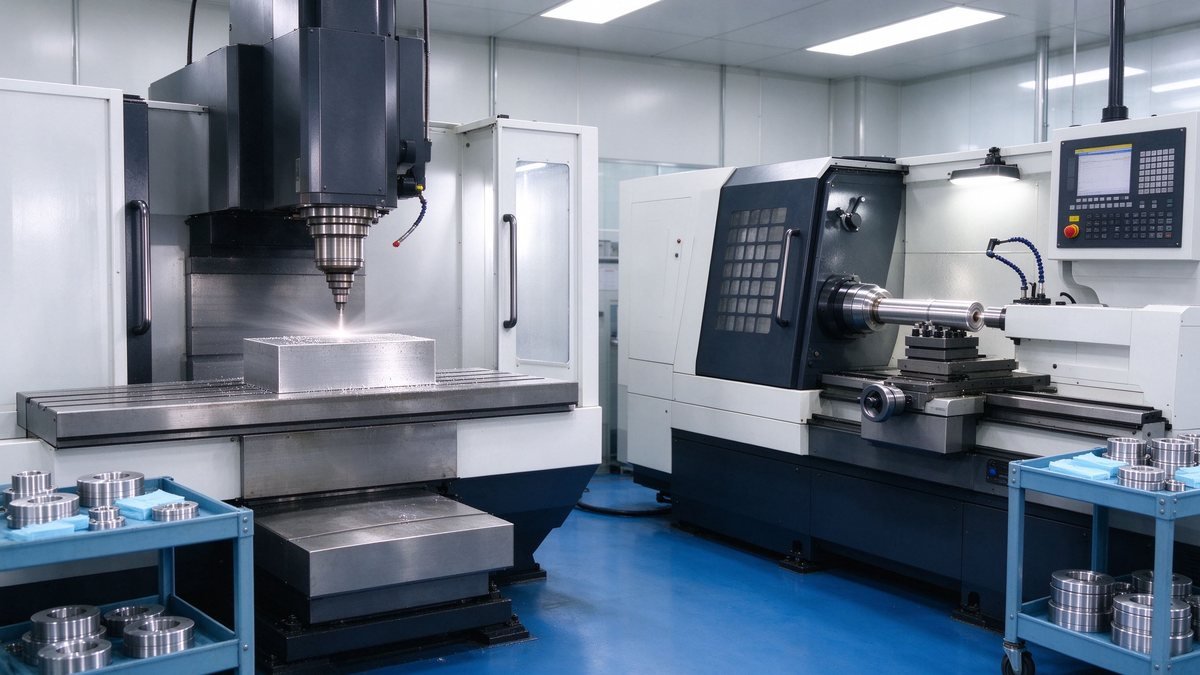
What is CNC milling?
CNC milling is a subtractive process where a rotating multi-point cutting tool removes material from a workpiece that is clamped on the machine table. The tool moves in up to three linear axes (X, Y, Z), and on a 3-, 4- or 5-axis machine it can reach angled and multi-sided faces. Milling produces flat faces, pockets, slots, cavities, holes, threads and complex 3D contours from a solid block or plate.
It is the most versatile process for prismatic parts — housings, brackets, manifolds, panels, plates, jigs and moulds. See our CNC milling services for typical parts and tolerances.
What is CNC turning?
CNC turning (lathe work) spins the workpiece in a chuck while a fixed single-point cutting tool feeds into the rotating stock to remove material. Because the part turns around an axis, turning creates rotationally symmetric components — shafts, pins, bushings, sleeves, rings, fittings, threaded connectors and rollers. Modern turning centres add live tooling, a secondary spindle and C-axis/Y-axis, so they can mill flats, drill cross-holes and cut keyways on the same machine.
Turning is fast and economical for round, high-volume parts and delivers excellent concentricity and fine surface finishes. Examples are on our CNC turning services page.
Key differences at a glance
- Part geometry: milling suits prismatic, blocky and contoured parts; turning suits cylindrical, axial parts.
- How material moves: in milling the tool rotates and the stock is fixed; in turning the stock rotates and the tool is fixed.
- Typical features: milling makes pockets, flat faces, 3D surfaces and cavities; turning makes diameters, tapers, grooves, knurls and external/internal threads.
- Setup for multi-sided work: complex multi-sided prismatic parts benefit from 5-axis machining, while round parts with secondary holes benefit from live-tool turn-mill.
- Speed at volume: turned round parts are often faster per piece; milled parts depend on the amount of material removed and number of setups.
When to choose CNC milling
Choose milling when your part is not rotationally symmetric — for example electronics housings, mounting brackets, hydraulic manifolds, heatsinks, front and base plates, optical breadboards, enclosures, jigs, moulds and structural parts. Milling is also the right choice when you need large flat surfaces, precision pockets, tapped holes on different faces, or free-form 3D geometry. Large aluminium plates and machine beds are handled on our gantry machining centres.
When to choose CNC turning
Choose turning when your part is built around an axis — shafts, pistons, rollers, bearings seats, spacers, nozzles, inserts, nuts, threaded fittings, standoffs and medical/fluid components. Turning gives roundness, consistent wall thickness and smooth OD/ID surfaces very efficiently, and it is especially cost-effective for free-cutting materials such as brass and free-machining aluminium. Very small, high-precision long-and-slender parts can be made on a Swiss-type lathe.
Combined turn-mill and 5-axis options
Many real parts mix round and prismatic features. A turn-mill / multi-task machine turns the main body and then uses live tooling to mill flats, drill cross-holes and cut threads without re-fixturing, improving accuracy and reducing lead time. Separately, 5-axis milling reaches several faces of a complex prismatic part in one clamping. Our DFM review recommends the most cost-effective route — we do not push a part to a more expensive machine when a standard mill or lathe is enough.
Unsure whether your drawing is a milled or turned part? Send the STEP file and our engineers will confirm the process, tolerance and price within 24 hours, or compare when 5-axis machining is worth it.