
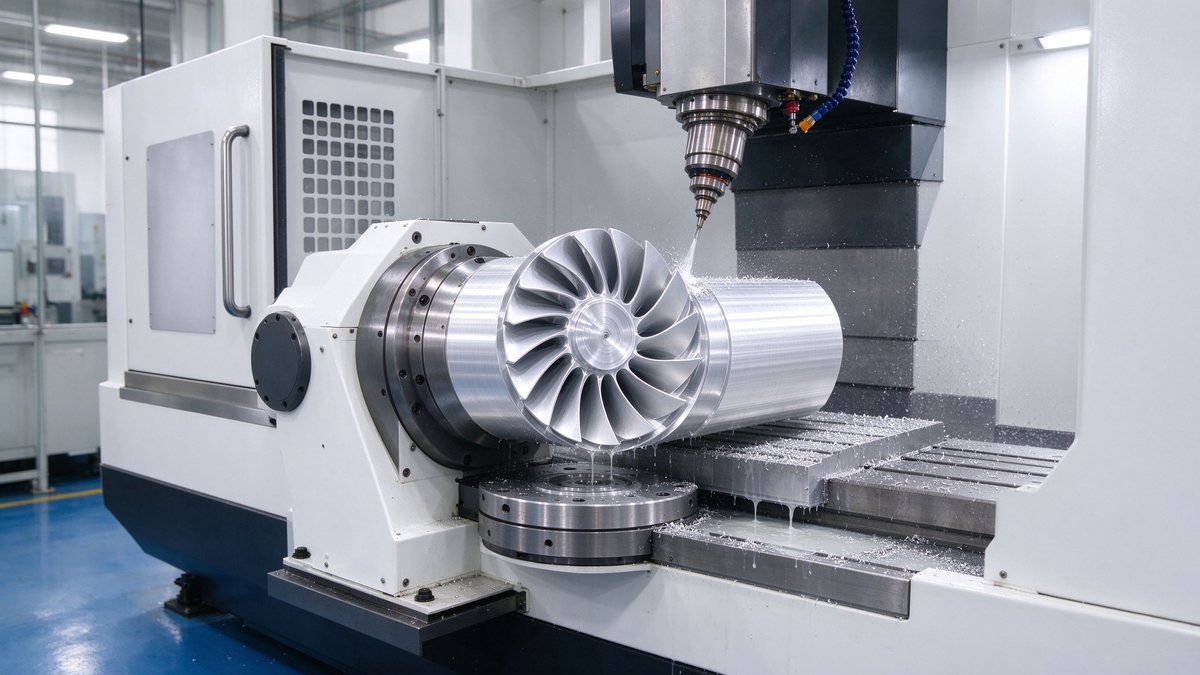
What is 5-axis CNC machining?
A conventional 3-axis machine moves the tool along X, Y and Z. A 5-axis machine adds two rotary axes (the A and B or C axes) so that the tool can approach the workpiece from almost any angle. This is achieved either by tilting the spindle head, by rotating the table that holds the part, or by a combination of both. The result is the ability to machine five faces — and continuous free-form surfaces — without manually repositioning the part.
You can see the full range on our 5-axis CNC machining services page, including impellers, blisks, turbine blades and robotics joints.
Simultaneous (continuous) vs 3+2 indexed
- Simultaneous / continuous 5-axis moves all five axes together while cutting. It is required for swept surfaces such as impeller blades, blisks, helical rotors and complex moulds where the tool angle changes continuously along the path.
- 3+2 (indexed or positional) machining sets the rotary axes to a fixed angle and then machines with the three linear axes. It is the fast, economical way to reach multiple faces of prismatic parts, multi-angle holes and undercut features in one clamping.
We recommend true continuous 5-axis for genuine free-form geometry and 3+2 for five-sided prismatic parts — most jobs fall into one of these two clearly.
Benefits of 5-axis machining
- Fewer setups. Five faces in one fixturing removes repeated manual alignment and the tolerance stack-up that comes with it.
- Tighter accuracy. One reference frame means features on different faces stay aligned to ±0.01 mm on critical dimensions.
- Better surface finish. The tool reaches surfaces at the ideal angle, shorter cutters can be used, and scallop marks are reduced — often eliminating a polishing step.
- Shorter lead time. Less handling and fewer operations speed up complex prototypes and low-volume production.
- Deeper and harder-to-reach geometry. Tilted tool access clears cavities and undercuts that a 3-axis machine simply cannot reach.
Parts that benefit most
5-axis is the natural fit for impellers and blisks, turbine and compressor wheels, turbine blades, centrifugal and pump impellers, medical implants with organic surfaces, robot joint housings, wrists and end effectors, aerospace structural components, complex mould cores and cavities, and multi-port valve and manifold bodies with angled faces. If a part needs features on three or more faces, compound angles or a continuous sculpted surface, 5-axis usually wins.
Cost: when is 5-axis worth it?
5-axis machines have a higher hourly rate than 3-axis, but they are not always more expensive overall. For a complex multi-sided part, completing it in one setup can be cheaper than several 3-axis setups, with better accuracy and a faster delivery. For simple flat prismatic parts with features on one or two faces, 3-axis remains the lower-cost option. Our DFM review recommends the process by total cost — machine time, fixturing, handling and inspection — rather than the headline hourly rate.
Materials, tolerance and documentation
We 5-axis machine aluminium (6061/7075), stainless steel, titanium Ti-6Al-4V, Inconel and other nickel alloys, brass, copper and engineering plastics using rigid setups, high-pressure coolant and wear-resistant tooling. Standard tolerance follows ISO 2768-mK and we routinely hold ±0.01 mm on critical features with Ra 0.8–1.6 finishes. Mill test certificates (EN 10204 3.1), first-article inspection and CMM reports are available on request. Send your drawing for a 5-axis quotation, or learn about CNC milling vs turning.