European manufacturers and machine builders increasingly source custom CNC parts from China to control cost, access spare capacity and shorten development cycles. The common concern is not price — it is quality, communication and delivery certainty. This guide explains how shipping terms, lead times and quality control actually work, so you can source with confidence.
Why source CNC parts from China
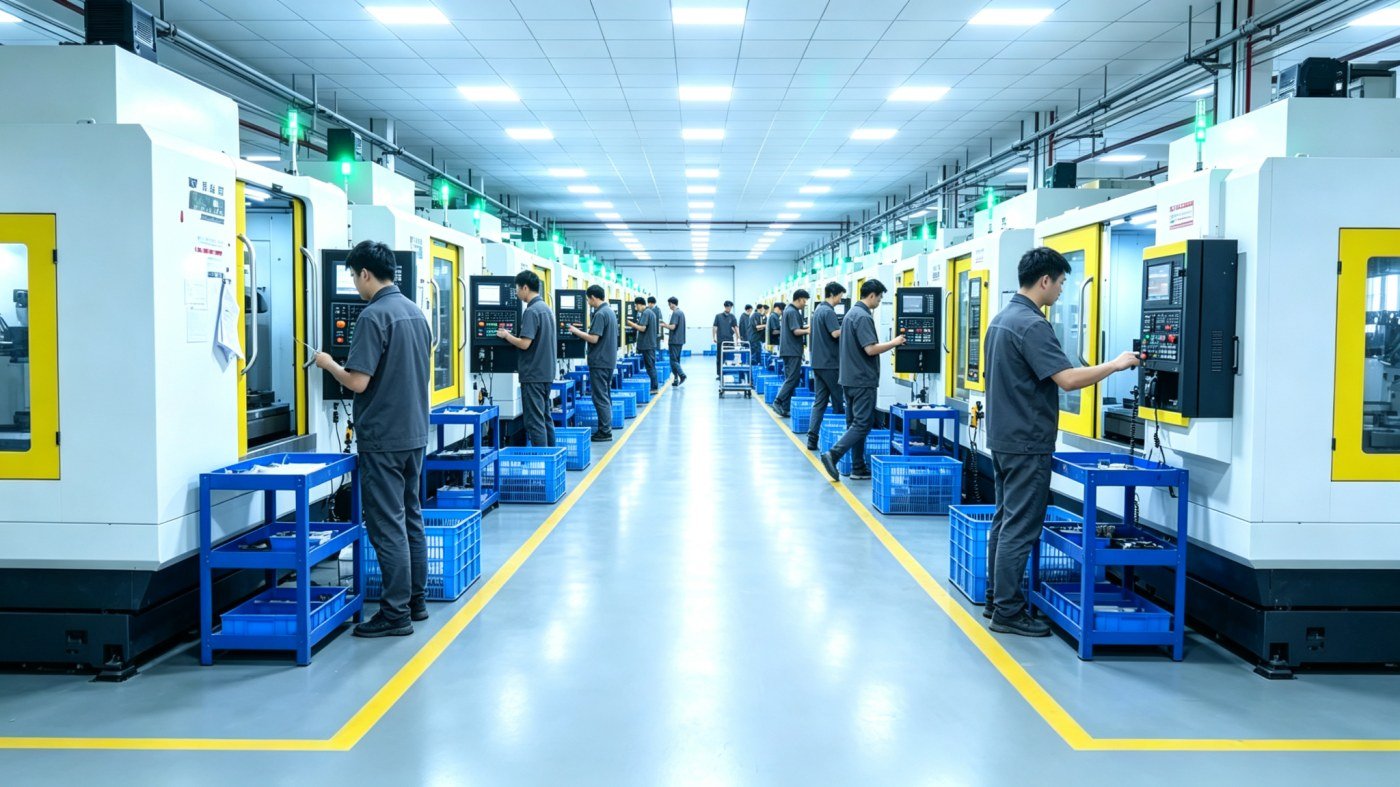
A well-equipped Chinese CNC manufacturer combines a large machine base, fast material availability for aluminium and stainless steel, skilled process engineers and competitive labour cost. For custom, low-to-mid volume parts — prototypes, automation components, gantry plates, housings and precision assemblies — the total landed cost and lead time are often better than local sourcing, provided quality is managed. YOUSU has run an ISO 9001 factory in Shenzhen since 2014 and exports to customers in Germany, France, Italy, Spain and other EU countries.
EXW, FOB and DDP explained
- EXW (Ex Works): you collect the goods at the factory and arrange all transport and clearance yourself. Lowest supplier price, most work and risk for you.
- FOB (Free On Board): the supplier delivers the goods onto a vessel and handles export in China; you manage the main carriage, import, duty and VAT.
- DDP (Delivered Duty Paid): the supplier handles transport, export and import clearance, duty and VAT, delivering to your door. For many European buyers this is the simplest, most predictable option — you receive one price and the parts arrive at your facility.
We quote all three terms and recommend DDP for first-time buyers and lower-shipment-value orders, so there are no surprise customs charges.
Shipping options and realistic lead times
- Express courier (DHL/FedEx/UPS): roughly 4–8 days door-to-door, ideal for prototypes and small batches up to a few hundred kilograms.
- Air freight: roughly 7–12 days, suited to larger or urgent shipments.
- Sea freight (LCL/FCL): roughly 30–45 days to European ports, the cheapest option for heavy, high-volume parts such as large aluminium plates.
Add production time: CNC prototypes typically take 5–10 working days, and production batches depend on quantity, material and finish such as anodising. We will always confirm the production schedule and shipping plan in writing on the quote.
Controlling quality from a distance
Quality control is a process, not a promise. To de-risk a China order:
- Work with an ISO 9001 certified supplier that documents its process.
- Provide complete 2D drawings with tolerances, material and finish (a 3D model alone is not enough).
- Approve a first article, and request CMM inspection reports, material certificates and photos before shipment.
- Use a free DFM review to catch design issues before cutting metal.
- Sign an NDA and keep one engineering contact for the whole project.
At YOUSU, in-process inspection, first-article inspection and final CMM inspection are standard, with reports available on request. The equipment and metrology section shows our machines and inspection lab.
Buyer checklist
- STEP/STP 3D model plus 2D drawing with tolerance, grade and finish.
- Annual/monthly quantity and target delivery date.
- Preferred incoterm (we suggest DDP for the first order) and shipping address.
- Any required certificates or material traceability.
- NDA requirements and the person authorised to approve samples.
The process takes about five steps from RFQ to delivery — see our RFQ-to-delivery workflow. Send your drawings now for a quotation within 24 hours, and compare our process with our guide on large aluminium plate gantry machining.