
Why brass and copper machine so well
Brass and copper are among the easiest and fastest metals to CNC machine. They are soft, chip freely and form short, non-stringy swarf (especially free-cutting grades), allow high spindle speeds and feeds, cause little tool wear and produce excellent as-machined surface finishes. This combination makes brass and copper components unusually cost-effective for precision turned and milled parts, even in modest quantities.
Common grades we machine
- C36000 / C3604 free-cutting brass (leaded brass) is the workhorse for turned fittings, nuts, connectors, valve seats and nozzles — it cuts very fast and holds fine detail.
- C38500 architectural bronze and C46400 naval brass for higher-strength and corrosion-resistant marine hardware.
- C11000 / C10100 oxygen-free copper (ETP/OFHC) for electrical and thermal components that need maximum conductivity.
- Copper-tungsten and tellurium copper (C14500) for electrical discharge electrodes, contacts and welding consumables that must stay conductive while being more machinable.
Typical turned brass and copper parts
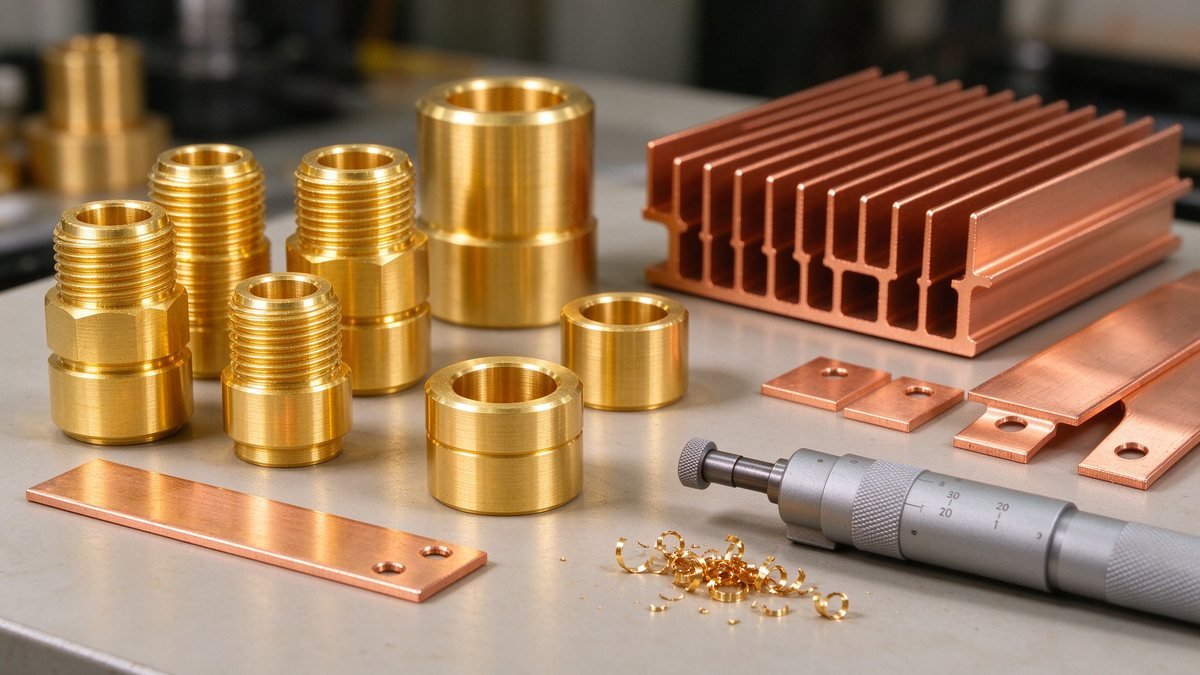
CNC turning dominates brass production because most brass parts are axial: threaded fittings and adapters, compression fittings, hose barbs, bushings and sleeves, knurled knobs and nuts, valve seats and bodies, nozzles and spray tips, RF and electrical connectors, standoffs, inserts, pneumatic fittings and plumbing/fluid components. Swiss-type turning handles very small, long or high-precision brass components. See our CNC turning parts for examples.
Copper heatsinks, busbars and electrodes
Where conductivity matters, copper is milled rather than turned. We CNC mill and drill copper heat sinks and cold plates for high-power electronics and lasers, copper busbars and terminal blocks for power distribution, EDM (spark erosion) electrodes, and contact/electrode components. Copper's high thermal and electrical conductivity cannot be matched by aluminium in demanding power and thermal applications. We also machine copper prototype parts that later become die-cast or stamped components.
Design and tolerance tips
- Use free-cutting brass for economy — it permits the fastest feeds and best finish and is usually the cheapest to make.
- Thin walls and fine threads are achievable in brass; still keep walls >0.5 mm and add an undercut at the end of threads where practical.
- Specify the copper grade by conductivity need — OFHC/C10100 for premium electrical, ETP/C11000 for general thermal use.
- Account for copper's softness on sealing and wear surfaces; switch to brass or bronze where a bearing/wear surface is needed.
- We can hold ±0.01 mm on critical features and add knurls, cross-holes, milling and threads on turn-mill machines.
Finishing and getting a quote
Brass and copper parts are commonly supplied as-machined, with optional degreasing, electropolishing, passivation, tin or nickel plating, and clear lacquer to stop tarnishing. Copper heat sinks may be nickel-plated for corrosion protection. Tell us the grade (or just the electrical/thermal requirement), thread forms, sealing surfaces and quantity. Request a quote with your STEP file, or compare aluminum vs stainless steel for other metals.