
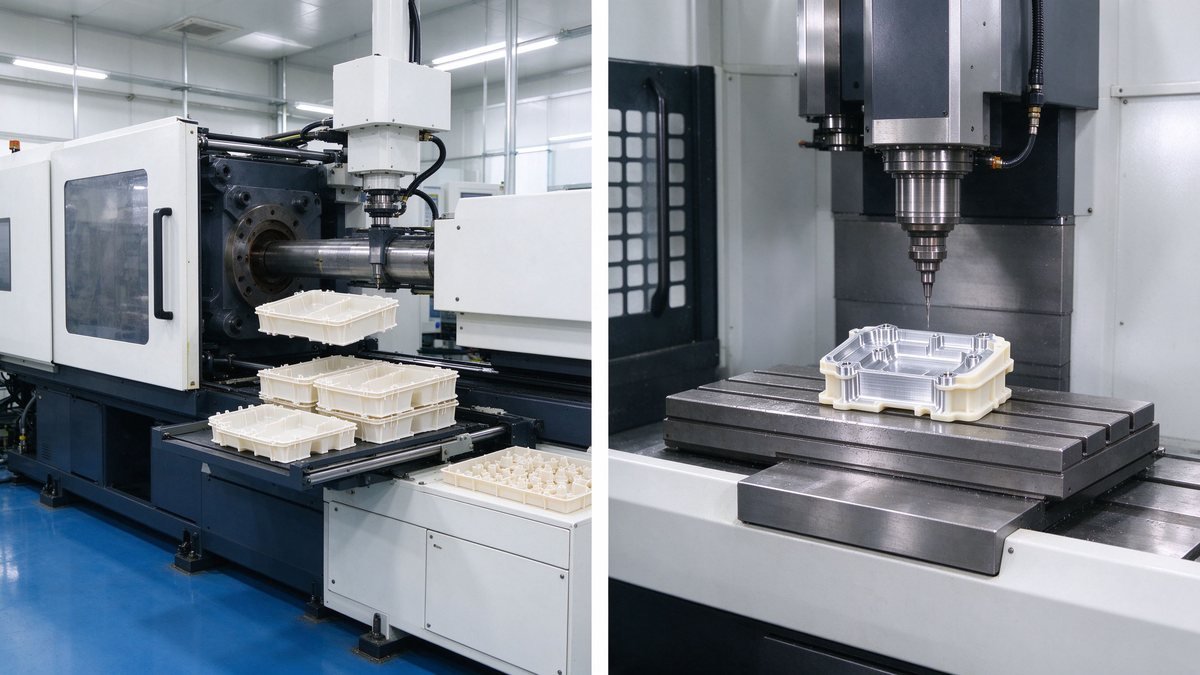
Both processes make plastic parts
Engineering plastic parts can be produced by CNC machining (cutting a block of solid plastic) or by injection molding (melting pellets and injecting them into a steel mould). Both are accurate, repeatable and widely used in industry, but they suit very different quantities, geometries and budgets. Choosing correctly at the design stage saves time and money.
CNC machining plastic parts
Machining starts from an extruded or compression-moulded sheet, rod or plate of solid plastic and removes material. It works with PEEK, PEI (Ultem), POM (Delrin), PPS, UHMWPE, nylon, PC, HDPE, PTFE and more. Because the plastic is already fully cured and stress-relieved in stock form, machined plastics keep good mechanical properties and tight tolerances — an advantage for PEEK and glass-filled grades. There is no mould, so parts ship in days and design changes are cheap.
Injection molded plastic parts
Injection molding forces molten thermoplastic into a machined steel mould. Once the mould exists, each part cycles in seconds, so the per-part cost at volume is very low and repeatable. Molding is ideal for complex, thin-walled and detailed parts with ribs, bosses, snap-fits and fine surface texture that would be difficult or slow to machine. Learn more on our custom plastic injection molding services page.
Side-by-side comparison
- Upfront cost: CNC has no tooling cost; injection molding requires a mould that is paid for up front.
- Lead time: CNC parts in days; first moulded parts typically 3–6 weeks after the mould is built.
- Per-part cost: higher for CNC; very low for molding once volume justifies the mould.
- Best quantity: CNC for 1 to a few hundred; molding for the hundreds to millions.
- Materials: CNC uses a wide range of stock plastics incl. high-performance PEEK; molding uses mouldable grades and can colour and fill the resin.
- Tolerance & properties: machined solid plastics hold tighter dimensions and full stock-grade properties; moulded parts need to manage shrinkage, weld lines and warp.
- Geometry: molding excels at thin walls, ribs and complex shells; CNC handles thick blocks, plates, gears and tight-tolerance parts.
When to choose CNC machining
Choose CNC for prototypes and first articles, low-volume production (roughly 1–200 parts), tight-tolerance and high-temperature parts, small or unpredictable demand, and designs that may still change. It is also the right choice when you need the guaranteed mechanical properties of solid PEEK/PEI or the same part delivered immediately without mould lead time. We can also machine the mould itself (mould cores and cavities) in tool steel or aluminium.
When to choose injection molding
Choose molding once the design is stable and volume is in the hundreds or more, for thin-walled housings, enclosures, consumer/automotive components, gears and handles, and where consistent low unit price, colour, fine texture and complex features matter. A common, low-risk path is to CNC prototype the part first, prove the design, then cut the mould and move to molded production — and we can support both, including machining the mould tool. Tell us the plastic, quantity and timeline for a recommendation, or see choosing PEEK, PEI or POM.