If your part is small, long, slender or has tight concentricity — a bone screw, an RF connector center, a watch pinion, a valve stem — you have probably seen quotes for both "Swiss turning" and "CNC turning". They are not the same machine, and choosing wrong costs money twice: once in the quote, once in scrap. This guide explains the real difference and gives you a decision rule you can use today.
What is Swiss-type CNC turning?
A Swiss-type lathe feeds the bar stock through a guide bushing positioned very close to the cutting tools, while the entire headstock slides along the Z-axis. Because the bar is supported right at the cut, long and slender parts do not deflect or chatter. Swiss machines almost always combine a main spindle, a sub-spindle and live (driven) tooling, so a part can be turned, milled, drilled, cross-drilled and threaded in a single cycle — complete, off the machine.
Swiss machines are typically used for bar diameters from about Ø1 mm to Ø32 mm, with length-to-diameter ratios beyond what a fixed-head lathe can hold straight. They are the standard process for medical, dental, watchmaking, electronics-connector and aerospace-small-parts production.
What is conventional CNC turning?
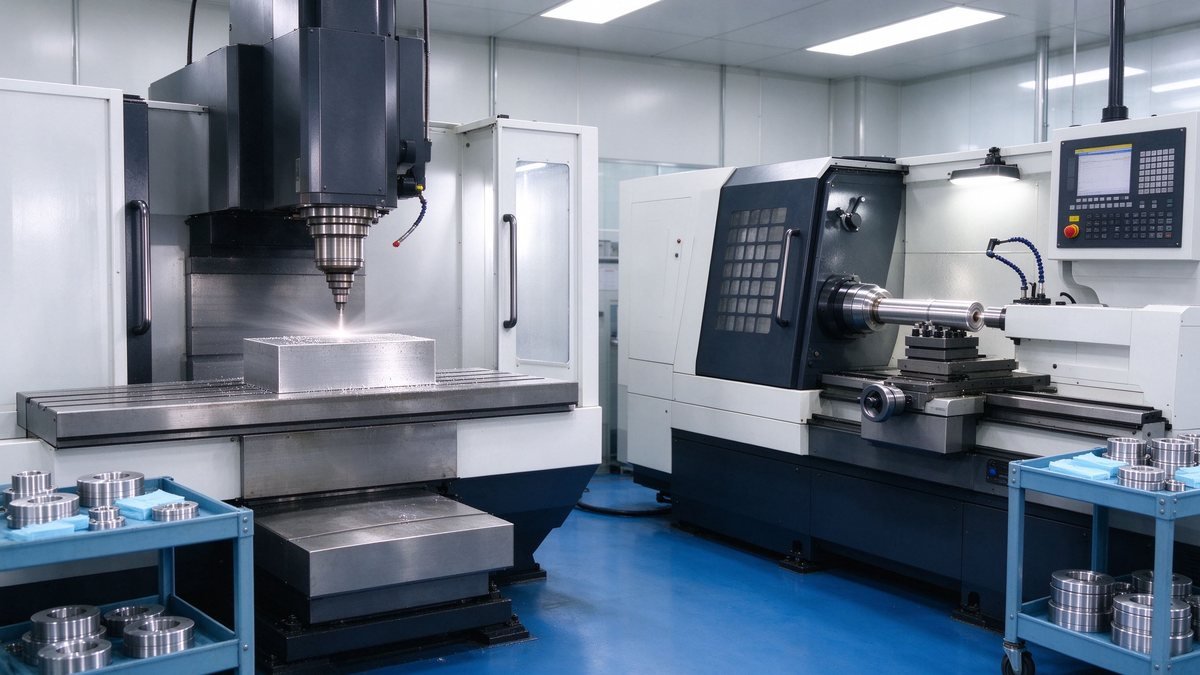
A conventional (fixed-head) CNC lathe holds the workpiece in a chuck while the turret moves tools to it. The work is stiff — short and stubby — which is exactly right for diameters from about Ø20 mm up to several hundred millimeters, for parts like housings, flanges, pulleys and larger shafts. Many fixed-head lathes also carry live tooling and a sub-spindle, giving "turn-mill" capability for mixed features.
Conventional turning is the more common and generally more economical process when the part is stiff enough to machine without deflection.
Swiss vs CNC turning: key differences
- Bar support: Swiss machines support the bar in a guide bushing right at the tool; conventional lathes support it only in the chuck or a tailstock. This is the single biggest difference.
- Diameter range: Swiss ≈ Ø1–32 mm; conventional ≈ Ø20 mm to several hundred mm. There is overlap around Ø20–32 mm where either can work — and where part geometry decides.
- Length-to-diameter ratio: Swiss machines comfortably hold 10:1, 20:1 or more; a fixed-head lathe struggles above roughly 3–4:1 without a tailstock or follow rest.
- Tolerance and finish: Swiss machines routinely hold ±0.005 mm on critical diameters with Ra 0.4–0.8 surfaces, because the bushing removes deflection; conventional turning typically quotes ±0.01 mm standard.
- Features in one setup: both can carry live tooling and sub-spindles, but Swiss machines are built around completing tiny parts in one cycle, which is why they dominate high-volume small-part work.
- Cost per part: Swiss is costlier per machine-hour but often cheaper per part at volume, because cycle times are short and parts come off complete.
When to choose Swiss turning
- Part diameter is below about Ø32 mm and length exceeds roughly 3–4× the diameter.
- You need very tight tolerances (±0.005 mm) or tight concentricity on a long, slender feature.
- The part needs turning plus milling, cross-drilling or threading in one setup — pins with flats, cannulated screws, connector shells.
- You are producing thousands to millions of identical small parts per year.
Typical examples: bone screws and dental abutments, RF and fibre-optic connector components, watch pinions and arbors, valve stems, sensor housings. We cover these in detail on our Swiss turning services page — including the materials and tolerances we run.
When to choose conventional CNC turning
- Diameter is above about Ø32 mm, or the part is short and stiff (length ≤ 3–4× diameter).
- You need large-diameter features, internal bores, or heavy roughing where bar support is irrelevant.
- The part is a housing, flange, pulley, coupling or similar larger turned component.
- You are prototyping a bigger part and want the fastest possible turnaround.
Conventional turning handles everything from Ø20 mm shafts to large flanges. See our CNC turning services page for the full capability range, and our custom CNC machined parts overview if you need turned and milled parts together.
Cost and lead time
Swiss machining costs more per machine hour than conventional turning — the machines are more complex and setups demand more skill. But for small, complex parts the total cost is usually lower: one setup instead of several, no deflection scrap, and cycle times measured in seconds rather than minutes. Conventional turning wins on larger, simpler parts, where its hourly rate advantage dominates.
For either process, prototypes from our shop typically ship in 5–10 working days, and DDP door-to-door delivery covers Germany, France, Italy, Spain and the USA. Send your STEP or PDF and our engineers will recommend the right machine during a free DFM review.
Still unsure which process fits your part? Upload your drawing via our online CNC quote form and we will tell you honestly — and quote both processes if it is close.