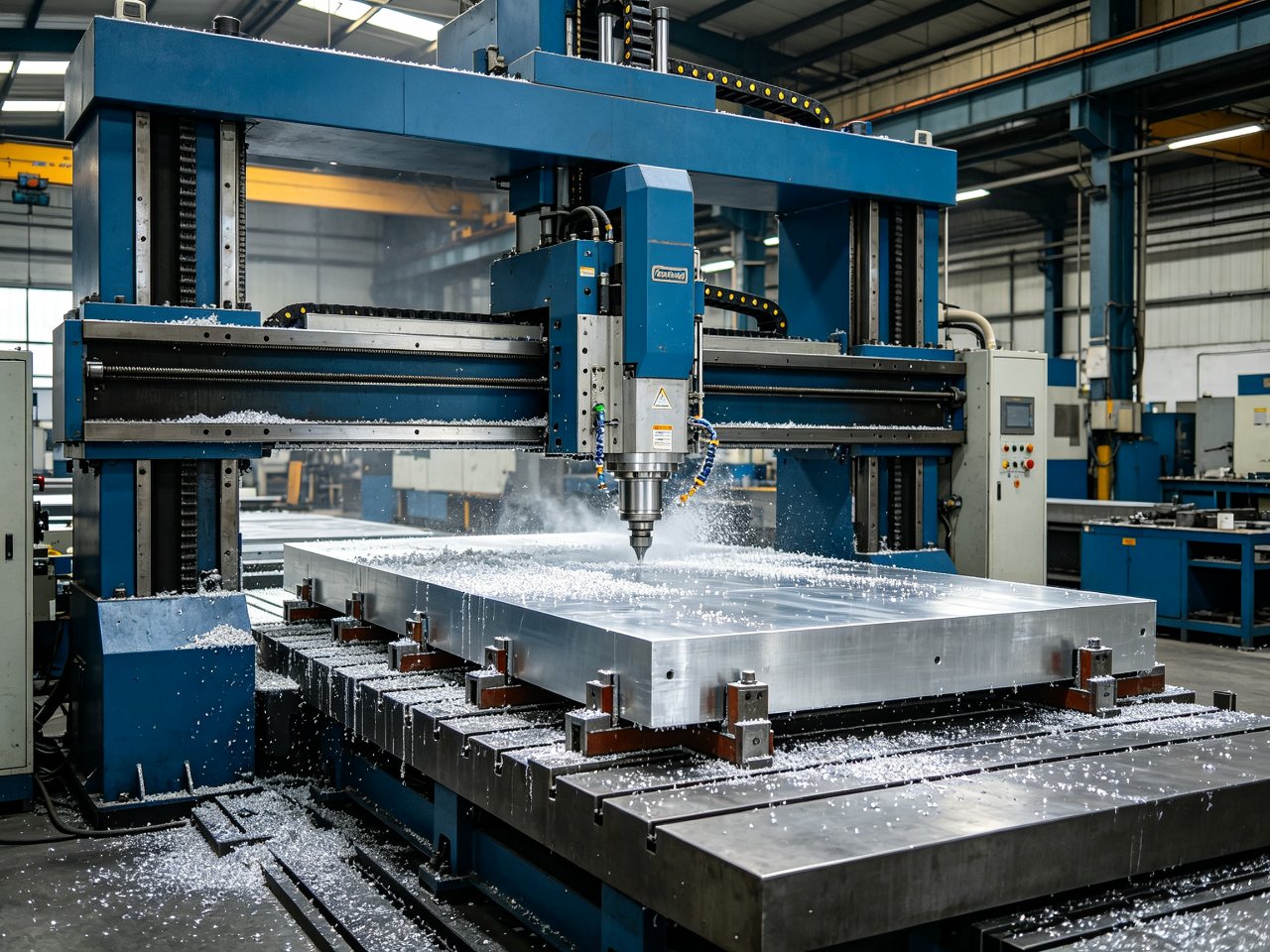
Automation cells, robotics, battery packs, laser and semiconductor equipment often rely on large, flat aluminium plates that act as mounting bases, fixture plates, tooling plates and liquid cooling plates. Producing these parts accurately is a different challenge from machining small components: the part is large, thin and prone to distortion, and the machining centres and workholding must be sized for it. This is exactly what large aluminium plate gantry machining is for.
What is a gantry CNC machining centre?
A gantry (or bridge-type) machining centre moves the spindle along a rigid bridge that travels over a long table. The open, rectangular bed accepts long and wide plates that simply will not fit on a standard vertical machining centre. The rigid structure and wide support span keep the cutter stable even at the far edges of a large plate, so accuracy is maintained across the whole surface rather than just in the centre. At YOUSU, gantry machining is one of our core capabilities, alongside 3-axis and 5-axis milling, turning, turn-mill and Swiss-type machining.
Typical large aluminium plate parts
- Base and mounting plates for machines, robots, automation modules and linear axes.
- Fixture and tooling plates with grids of tapped holes and locating pins for jigs and workholding.
- Liquid cooling plates with milled cooling channels, sealed and pressure-tested for electronics, power and battery applications.
- Linear-rail and structural plates with precision-machined reference surfaces for mounting guide rails and drives.
- Long cross-beams and sub-plates where parallelism of the two faces is critical.
Most of these parts are machined from aluminium 6061 or 6063, with 5083 and 7075 selected when higher strength or corrosion resistance is needed. See our gantry plate product gallery for representative examples.
Capabilities, tolerances and flatness
Large plates are usually face-milled on both sides to create parallel reference surfaces, then drilled, bored, tapped and pocketed. Common requirements include:
- Tight dimensional tolerances on hole positions and bore sizes, down to ±0.01 mm on critical features.
- Controlled flatness and parallelism across large areas, so rails mount without distortion.
- Precise hole-grid spacing for modular fixture plates.
- Anodising, sandblasting, brushing or other finishing after machining.
Because thin plates distort easily, experienced process planning matters: stress-relieved or cast/tooling-grade stock, symmetric roughing, staged finishing passes, and proper clamping all reduce spring-back. We use coordinate measuring machine (CMM) inspection to verify the finished plate, including flatness and hole-grid position, and provide dimensional reports on request.
Design tips for large plate machining
- Add a flatness callout on reference surfaces and specify whether a surface is a primary datum.
- Specify hole-grid pitch and thread sizes clearly on a 2D drawing; do not rely on the 3D model alone.
- Keep enough wall thickness under pockets and cooling channels to avoid flexing; very thin floors are difficult to keep flat.
- Note the material grade and temper (e.g. 6061-T6, 6063-T5, 5083) and whether milled, cast or tooling plate is acceptable.
- Allow for anodising growth on tight-fitting bores and threads (roughly half the film thickness builds on each surface). If in doubt, our engineers will flag this during DFM review.
Gantry vs vertical machining centre
A vertical machining centre is excellent for smaller, complex parts but is limited by its table size and spindle travel. A gantry machine trades a little of that small-part agility for a very large working envelope and excellent stability over long plates, so a single plate can be completed in one setup. Fewer setups mean fewer accumulated errors and better overall geometry — which is why large base plates, fixture plates and cooling plates are almost always better suited to a gantry machine.
From one engineering plate to repeat production batches, we can machine large aluminium parts to print and deliver worldwide, including DDP to Europe. Send us your drawing for a free DFM review and a quotation within 24 hours, or read about choosing between aluminium and stainless steel for your next project.